
THE TEA HOUSE • The Living Magazine
One Contract. Ten Years. Who Made Guo Yuxin Famous?
A short-drama breakthrough. A ten-year agreement. Then a warning to anyone thinking of hiring her. Guo Yuxin’s answer brought a contract clause, an unpaid-income allegation and seven months of history into the fight.

The dispute, in chronological order
- September 21, 2024
Agreement signed, according to the company. ↗
- September 20, 2025
盛夏芬德拉 launches, according to its co-producer. ↗
- January 12, 2026
Guo says she had not seen the responsible manager from this date onward. ↗
- January 26, 2026
Guo says she sent a termination notice. ↗
- February 2, 2026
Guo says she filed suit. ↗
- September 23, 2026
Company publishes its public warning. ↗
- September 24, 2026
Guo responds; the company publishes a rebuttal. ↗
The Tea House / Chapter 01
One contract. Ten years. A public warning.
Xinlezhi Culture put the industry on notice: anyone preparing to hire Guo Yuxin needed to speak to the company first. Its September 23, 2026 statement accused her of taking acting and commercial work without authorization. The agreement still bound her, the company said, and it had years left to run. [2][4]
The notice was aimed beyond the actress’s followers. It addressed producers, brands and anyone considering her for a project. There were named exceptions—玉簟秋 and a Baidu Maps voice pack—but for other cooperation the company demanded written approval. A fight over a private agreement had arrived at the door of her next employer. [4]
That is a powerful place to put a dispute. A producer might admire an actress and still hesitate over a role if another company is threatening legal action over her participation. A brand might want the audience she brings and dislike the uncertainty attached to hiring her. The warning did not have to settle the argument to make prospective collaborators pay attention.
The next day, Guo answered. She said the company had never held the sweeping authority it was claiming. The work that made her a short-drama star, she maintained, sat outside its management remit. And while the company accused her of bypassing it, she accused the company of keeping money that belonged to her. [1]
Then came the detail that changed the chronology: according to Guo, she had notified the company of termination in January and sued in February. The September confrontation was the public eruption of a relationship she said had already broken down months earlier. [1]
The company responded again. This time its argument reached beyond permission and payment. It challenged the story Guo was telling about her own success.
Who had brought in the opportunities? Who had done the work? And once an actress had become valuable, who was entitled to claim a share of what came next?
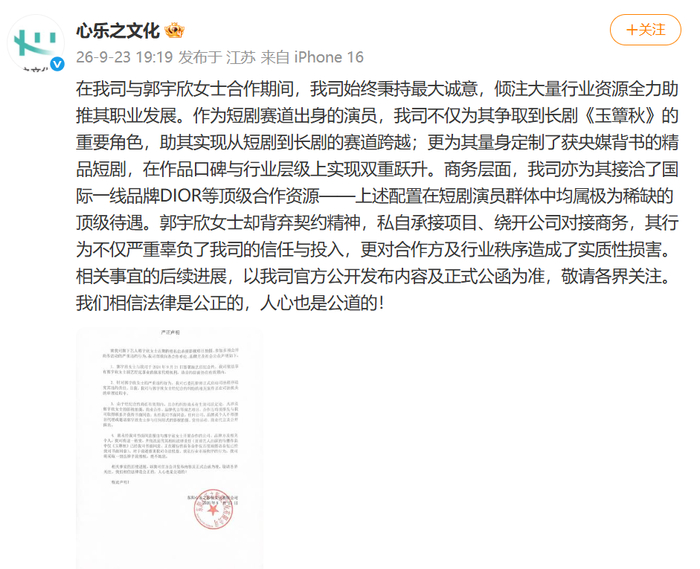
The company accuses Guo of taking work without authorization and describes its contribution to her career.
Toadstool Press · English summaryThe Tea House / Chapter 02
Before the warning, there was the breakout
The title at the center of Guo’s short-drama breakthrough was 盛夏芬德拉. It belongs to an entertainment world built for the phone: vertical framing, brief installments and the ability to move a viewer from one emotional complication to the next without asking for an hour of uninterrupted attention.
These dramas can make the familiar machinery of romantic television move at extraordinary speed. A family arrangement becomes an engagement. Affection develops inside an unequal relationship. A misunderstanding breaks the couple apart, and pursuit supplies the next reason to keep watching. The appeal lies in what happens between the reversals as much as in the reversals themselves.
In this production, Guo starred opposite Liu Xiaoxu under director Mu Yu. The story pairs freelance photographer Bai Qingmei with wealthy businessman Zhou Sheng’an: a family-arranged engagement develops into attachment, followed by a broken engagement and his pursuit of her. The co-producer’s account places its launch on September 20, 2025, on Hongguo and Douyin’s Majiuchang channel. [6]
The scale is easier to grasp with numbers. In an October 11 report, the Hubei production group said the drama had passed one billion recorded plays in four days and three billion in eighteen. It reported more than 6.94 million saves and 12.2 million likes on Hongguo. These were the production side’s figures, and they describe a very different order of attention from an actress quietly waiting for a supporting role to lead somewhere. [6]
For a performer, a hit in this market can change the bargaining position. The audience arrives through the work itself and carries its interest into the next production, an interview, a commercial appearance or a fashion event. The question is no longer only whether a gatekeeper will grant access to a conventional television audience. It is who gets to negotiate around an audience that already exists.
That makes the dispute over vertical short dramas particularly consequential. Guo did not merely argue that she had worked hard within the company’s system. She said the category in which she had built her success was outside its authority. [1]
Put that beside the company’s account and the fight becomes sharper. Xinlezhi described resources invested and doors opened. Guo described self-funded work and a business category she had retained for herself. The same breakthrough could be presented as the return on an agency’s investment or as an independent achievement the agency was trying to bring under its control.
The ten-year agreement was signed in September 2024, according to Xinlezhi. The drama’s September 2025 release therefore gave the company a simple chronological argument: the success came after the signing. Guo’s answer was about a different sequence—the partners who approached her side, the costs she paid and the work she said Xinlezhi was never authorized to manage. [1][2][6]
The Tea House / Chapter 03
The warning was addressed to her next employer
The agency’s notice did two jobs at once. It accused Guo of breaking an existing agreement, and it told the rest of the industry how it expected future business to be handled. The second part is what gave the first its immediate commercial force.
Xinlezhi said the agreement had been signed on September 21, 2024, for a ten-year term and remained in effect. On the company’s account, this was not a relationship nearing its natural end. It was an arrangement with most of its stated duration still ahead of it. [4]
Its public post named the longer-form drama 玉簟秋 and claimed that the company had secured an important role for Guo. It also referred to short-drama work with central-media backing and business contacts involving Dior. The company used those examples to portray the relationship as one in which Guo had received unusually valuable support. [2]
The stamped notice then addressed cooperation directly. It demanded written consent for projects involving her and threatened to pursue responsibility for unauthorized arrangements. It listed 玉簟秋 and a Baidu Maps voice pack as exceptions. [4]
Those exceptions make the notice more revealing. The dispute was not happening in a world where no one could identify approved work. Specific projects had been named. The conflict concerned what happened beyond that boundary: which engagements required approval, which had been authorized, and which Guo believed she could arrange independently.
The expression 接私活, often rendered as taking private jobs, compresses that disagreement into an accusation. It makes the artist sound as though she is slipping around an obligation to the company. But the force of the accusation depends on what that obligation actually covered. Guo’s response went straight to that point.
For a brand or a producer, the practical choice could be uncomfortable. Work with an actress whose audience it wants, and risk being drawn into a contractual fight; or wait, and lose the opportunity to someone else. That is how a warning directed at an artist can reach much further than her own account.
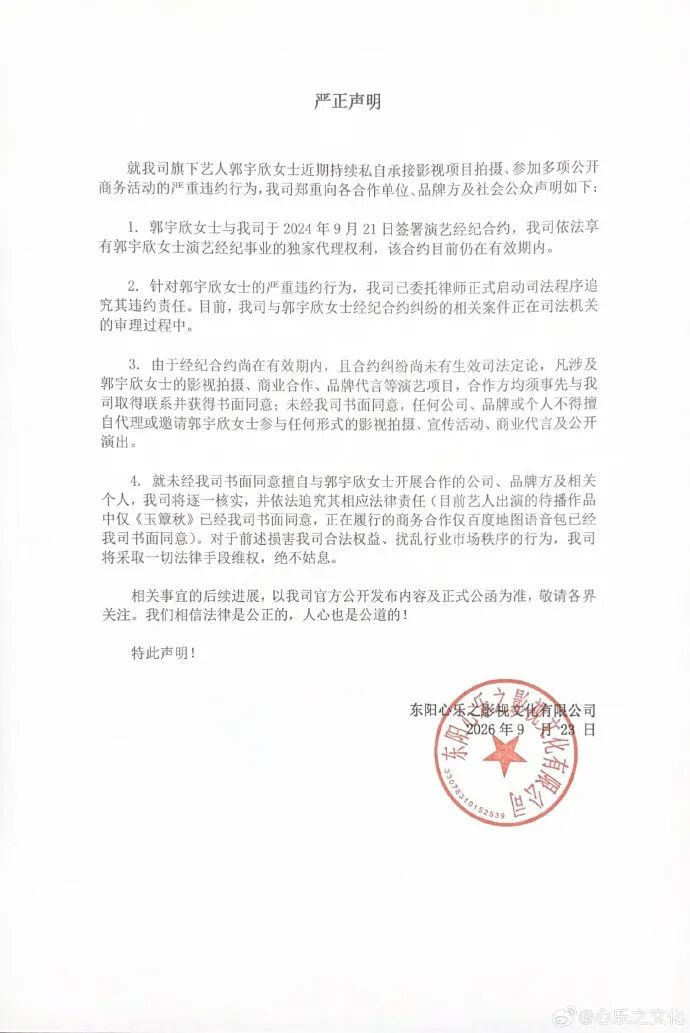
The notice demands written approval for cooperation, with stated exceptions for 玉簟秋 and a Baidu Maps voice pack.
Toadstool Press · English summaryThe Tea House / Chapter 04
Guo points to Clause 2.3
Guo’s answer began with the contract. She described Xinlezhi as a nonexclusive partner and pointed to Clause 2.3, which she said allowed her to carry out relevant business herself or entrust it to a third party. She said vertical short dramas and stage plays had been excluded from the company’s scope from the beginning. [1]
“乙方(郭宇欣)完全有权自行或委托第三方履行相关业务。”
“Party B (Guo Yuxin) is fully entitled to conduct the relevant business herself or entrust a third party to do so.” The sentence appears in Guo’s public response as her quotation of Clause 2.3. [1]
The difference between that wording and the agency’s warning is stark. One account begins with a requirement to obtain the company’s approval. The other begins with the artist’s right to act for herself. This is why Guo led with the clause: it challenged the company’s authority before she even reached its conduct.
She then made the boundary explicit. Vertical short dramas and stage plays, she said, were not included in Xinlezhi’s management scope. She described bearing the personnel and promotional costs of the vertical work herself. That was a claim about both permission and contribution: the work was outside the remit, and she said the company had not financed the machinery behind it. [1]
It was a direct challenge to the premise of the warning. If she retained the freedom she described, then independently arranging work was not automatically a betrayal of the agency. It was part of the arrangement she said they had made.
She also accused the company of withholding earnings. That reversed the direction of the confrontation: Xinlezhi was asking the industry to respect its contractual rights; Guo was asking why it had not met the obligations she said it owed her.
Her statement ended by returning to her work and the judicial process. But the line most likely to interest anyone considering hiring her was near the beginning: the company, she insisted, did not possess the exclusive control it was asserting.
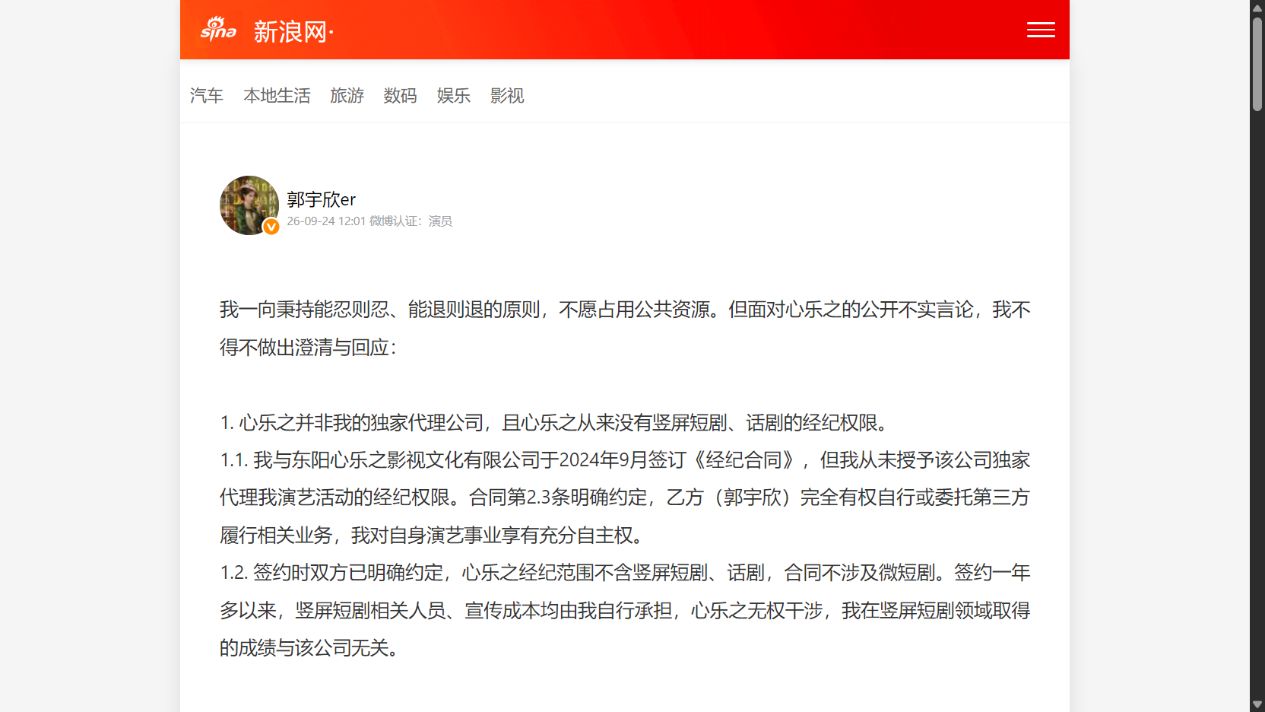
乙方(郭宇欣)完全有权自行或委托第三方履行相关业务。“Party B (Guo Yuxin) is fully entitled to conduct the relevant business herself or entrust a third party to do so.”
Toadstool Press · translation of the clause quoted in Guo’s responseThe Tea House / Chapter 05
January 12. January 26. February 2.
The most disruptive detail in Guo’s response was not a colorful insult. It was a calendar.
According to her account, the relationship had run into disagreement at the beginning of 2026. She said she wanted to sit down and resolve it, but neither her own attempts nor third-party mediation produced a meeting. From January 12 onward, she said, she had not seen the responsible manager. [1]
Fourteen days later, on January 26, she said she formally notified Xinlezhi that she was terminating the management agreement and ending their cooperation. A week after that, on February 2, she said she went to court to pursue unpaid earnings. [1]
September 23 now looked different. In the company’s announcement, Guo was an artist accepting work in breach of an ongoing agreement. In her response, she was someone who had been trying to leave and recover earnings for months. The public was being asked to judge a relationship whose parties did not even describe its present status in the same way.
The gap also explains why the word former becomes loaded in this kind of dispute. Calling someone a former manager announces that a separation has happened. Calling someone an artist under contract announces that it has not. A single label can carry the entire argument into a headline.
Guo’s chronology gave her statement a narrative the agency’s first warning did not contain: attempted meetings, a formal notice and a lawsuit before the public accusation. Xinlezhi’s next reply would respond to the fact that the matter was already before the courts, while continuing to insist on its position under the agreement. [1][3]
The September exchange was therefore not the start of the breakup. It was the point at which the breakup became something producers, advertisers and followers could watch—and something both parties now had to explain.
The Tea House / Chapter 06
The work, the account and the missing settlement
Guo’s financial allegation was specific about the route the money had taken. She said some acting projects were signed by Xinlezhi, with project payments sent into the company’s account. The unpaid earnings she described included acting fees and shares from commercial work. [1]
That route matters. A viewer sees the actress appear on screen or at an event. The payment may travel through the company that signed the engagement, with the artist receiving her agreed share afterward. In Guo’s version of the dispute, completing the work and having the project pay were not enough to get the earnings into her hands.
Xinlezhi did not answer simply by saying every sum had been paid. Its September 24 post asserted that her refusal to perform contractual obligations had caused substantial losses and that the company was entitled to pause settlement until a binding judicial determination. [3]
This was a collision between two accounts of obligation. Guo said: the projects generated income that you owe me. The company said: your conduct under the agreement gives us grounds to suspend settlement. Those positions pull the relationship in opposite directions. She was describing a reason to leave; it was describing a reason to retain leverage while the dispute continued.
The company’s account of contribution belongs beside that money argument. If it had introduced a project, negotiated the engagement and managed the work, those activities would be part of the story it wanted the public to recognize. Guo’s account instead placed the initial approach with partners contacting her side, followed by her former agent handling the next steps. [1][2]
An introduction, a negotiation, a signature and a payment are four different events. In a smoothly functioning partnership, an audience has little reason to ask who handled each one. In this dispute, those details became the difference between an agency doing its job and an agency claiming a share of an opportunity the artist said she had brought in herself.
That is why the argument about credit was not merely bruised pride. Credit was attached to the company’s commercial explanation for its rights—and to Guo’s explanation for why she wanted to be free of them.
The Tea House / Chapter 07
“The company isn’t a place for magical blessings”
Xinlezhi’s reply arrived at 5:36 p.m. on September 24. It asked whether the agreement had not been signed on September 21, 2024, and whether the successful short dramas that made audiences recognize Guo had not followed that date. It also pointed to its work on other projects. [3]
Then it reached for sarcasm. The company was not a 开光处, it said—a place where signing up magically blessed an artist and made every opportunity arrive on its own. Its point was blunt: Guo was discounting the team behind her. [3]
开光 is the consecration of a sacred image or object. In the agency’s metaphor, the company was rejecting the idea of a contract functioning like a lucky charm: sign the page, become blessed, and wait for resources to appear. It was a deliberately mocking image for what Xinlezhi regarded as the erasure of its team’s work.
The phrase supplied the reply with its sting. This was no longer the impersonal language of a formal notice. It was a company accusing an actress of rewriting the story of her ascent.
There is a difference between an opportunity arriving after a contract and an opportunity arriving because of the company. That gap is where the two accounts collide. Xinlezhi saw its work being erased. Guo said the company was claiming work it had not brought in.
On the agreement itself, the company stood its ground. It asserted restrictions on private dealings across long-, medium- and short-form dramas and commercial work. On the money, it argued that Guo’s alleged breach and the losses it claimed to have suffered entitled it to pause settlement pending a binding judicial decision. [3]
In other words, the two sides were offering very different explanations for the same unpaid balance. Guo described earnings being withheld. The company described a settlement it believed it was entitled to suspend.
Xinlezhi said it would not lay out its detailed evidence in the post. It also criticized taking the fight to Weibo and said it would leave the outcome to the courts. [3]
That ending created its own piece of drama. The company’s September 23 warning had already made the dispute public. Now it was telling the actress not to hold court on the same platform.
The reply also named October 2025 as the time 玉簟秋 had been approached. Dates and project names gave the rebuttal something more pointed than a general complaint about ingratitude. The company was asking readers to see a sequence of professional steps and to connect those steps to its presence. [3]
Its closing instruction—do not hold court on Weibo—used another phrase with a life beyond literal translation. 升堂 evokes a magistrate convening court. Applied to a social platform, it turns public accusations and replies into a makeshift hearing, with the audience invited to sit in judgment. [3]
That image was particularly awkward after the previous evening’s post. The company had used the platform to warn potential collaborators about Guo. Its final reply wanted the argument returned to the judiciary, after its own accusation had already entered the industry’s public conversation.
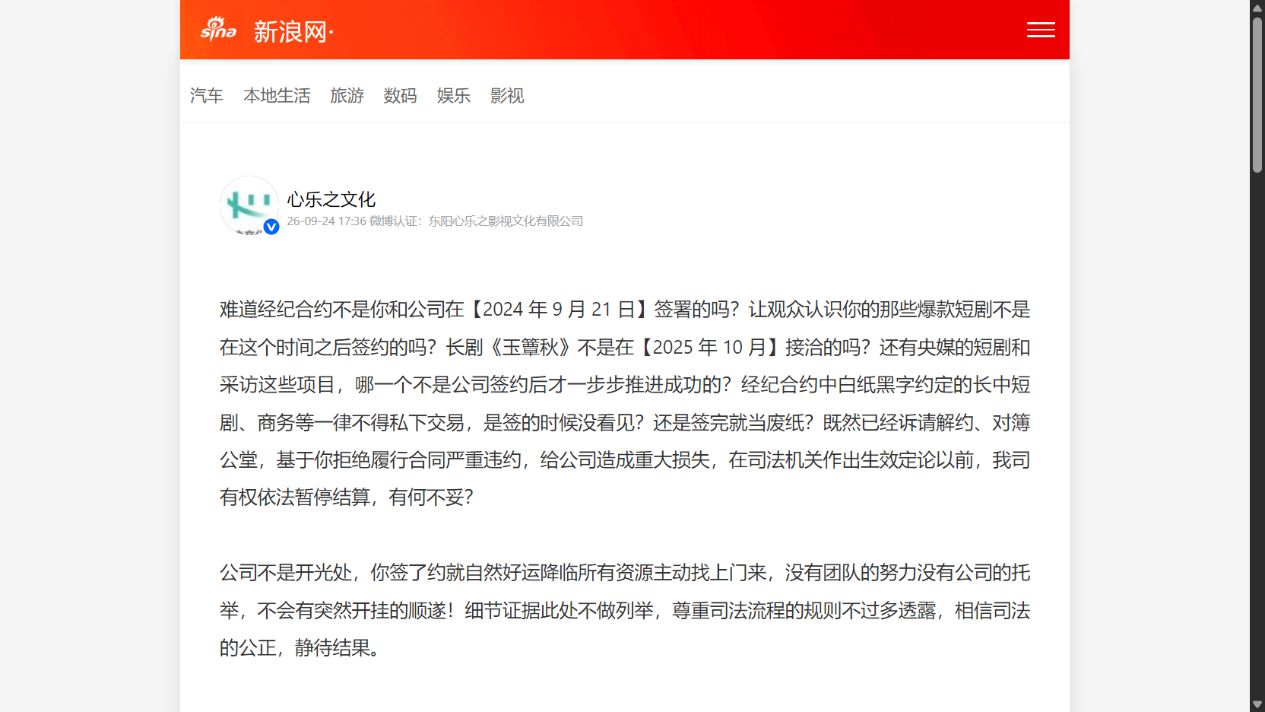
The company defends its contribution to Guo’s career, disputes her reading of the agreement and explains its position on settlement of earnings.
Toadstool Press · English summaryThe Tea House / Chapter 08
The reply that became its own spectacle
The first reaction did not need to wait for Guo’s answer. At 8:25 p.m. on September 23, television blogger 不交网友 highlighted the two projects named in the company notice and anticipated a protracted separation. [7]
“看来这个解约还要打好久……”
“Looks like this contract breakup is going to drag on for quite a while…” The sense of 打 here is a fight or battle; the post treats the termination as something that will have to be fought through. Its focus was on the warning’s practical reach, not a verdict on who had done the most work. [7]
Before the company’s evening rebuttal, one entertainment blogger had already turned its first statement into a punchline. At 12:39 p.m. on September 24, _TANG7 posted a sarcastic attack suggesting that the company’s announcement was helping send the company itself to its end. [5]
The phrase 送自己上路 supplies the dark joke: sending yourself on your way, with an implication of self-destruction. The appended “love you” emoji makes the post read as a taunt. It is the kind of reply designed to leave a mark, not negotiate a settlement.
What makes it revealing is the choice of target. The blogger was mocking the company’s attempt to seize the narrative. The statement meant to put pressure on Guo had become something an onlooker could use against its author.
That is the risk of fighting a management dispute in public. A formal warning gives a company a platform, but it also gives everyone else a text to dissect. The contract becomes a story; the phrasing becomes a screenshot; a sentence written to defend authority becomes a joke about losing it.
For Guo, a response built around independence, unpaid earnings and months of attempted separation offered a different story from the one in the company notice. For Xinlezhi, accepting that story would mean surrendering its account of both its contractual position and its contribution to her career.
Neither had much room to soften its version without conceding something important. The company wanted the agreement treated as binding. Guo wanted the industry to understand that she did not accept the control being claimed over her work.
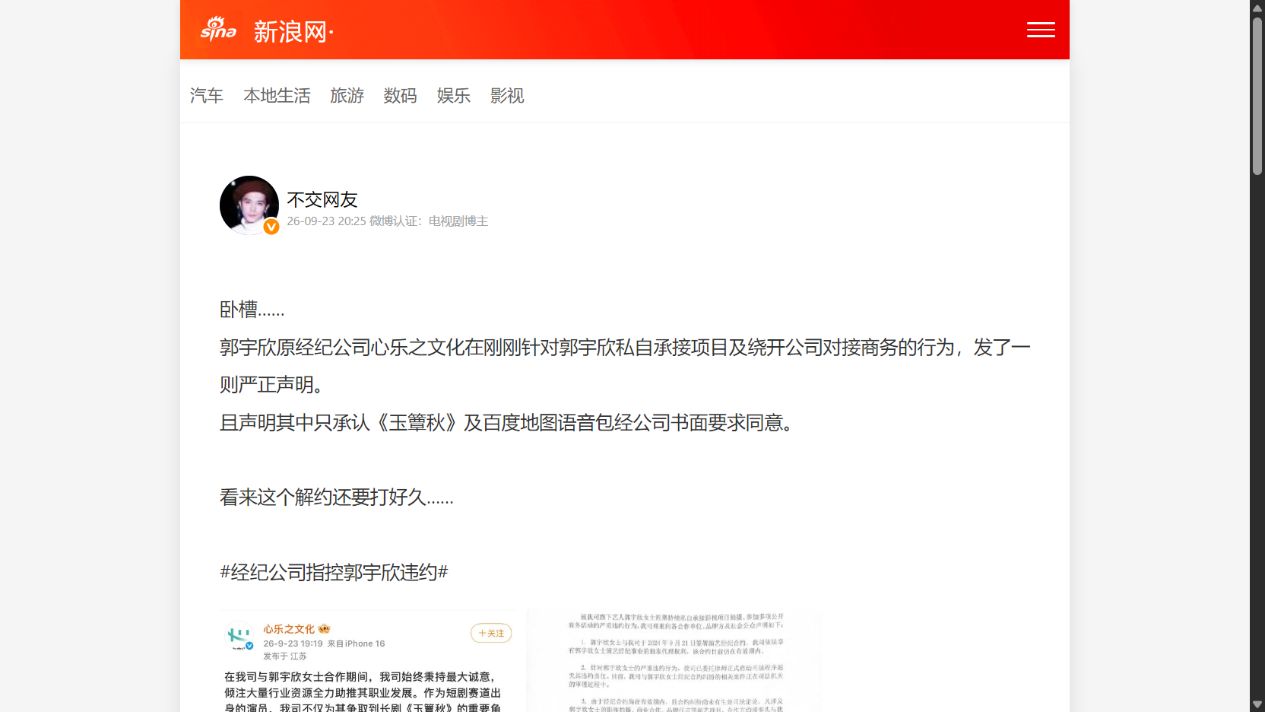
看来这个解约还要打好久……“Looks like this contract breakup is going to drag on for quite a while…”
Toadstool Press · selected-phrase translation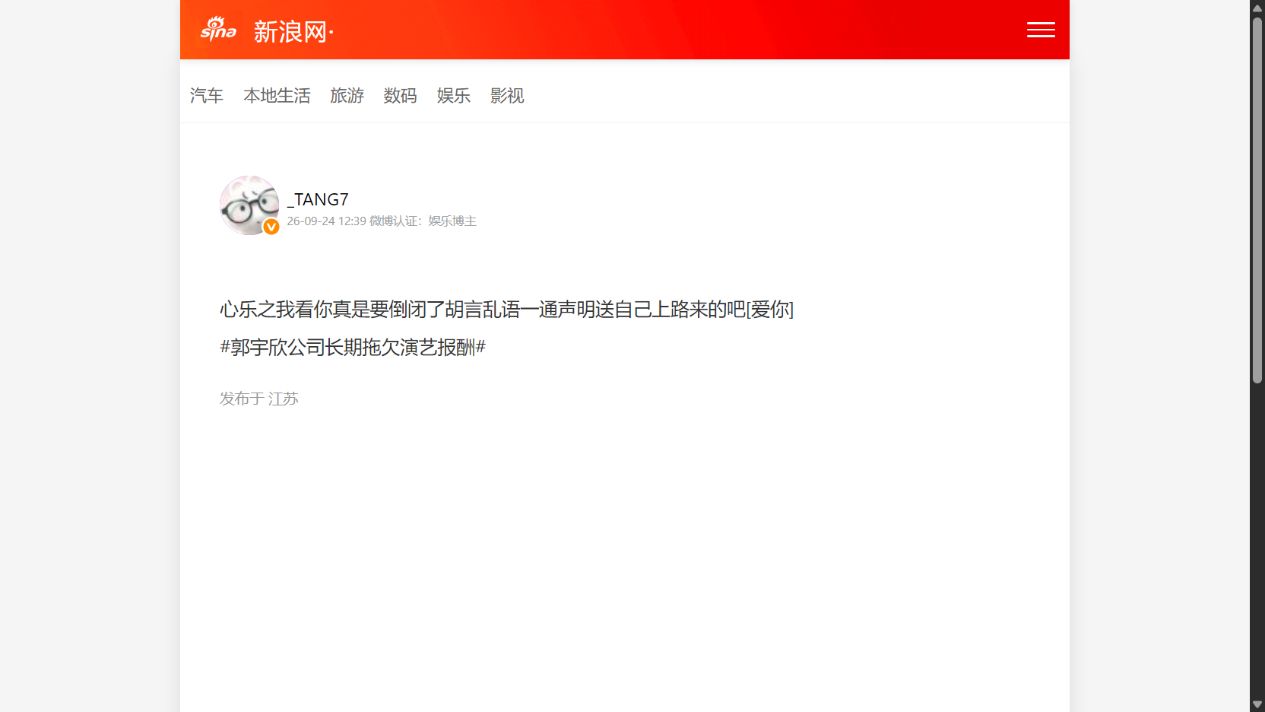
一通声明送自己上路“Sending yourself on your way with a statement.” The phrase 送自己上路 gives the criticism its dark edge: the blogger is mocking the company as the author of its own downfall.
Toadstool Press · selected-phrase translationThe Tea House / Chapter 09
Who gets to tell the success story?
By the end of the exchange, the dispute had acquired two layers. There was the working relationship itself: its scope, its income and the question of how it could end. Then there was the public account of that relationship, in which each side described who had helped whom.
Those stories have commercial consequences. An actress’s independence matters to the people who might hire her. An agency’s reputation for opening doors matters to the people who might sign with it. Neither side was arguing only about the past.
The unanswered questions are concrete. What does the complete agreement say about the disputed categories of work? Which opportunities did the company actually introduce or develop? What payments came in, what deductions were agreed, and what remained to be settled? Those are the records that could move the argument beyond competing posts.
Guo’s position was that the company was asserting authority it had never possessed while holding back income she had earned. Xinlezhi’s position was that an artist it had supported was evading the agreement and minimizing the team’s work. [1][3]
The conflict is compelling because both accounts reach toward something audiences recognize: the fear of doing the work and watching someone else claim it. Guo placed herself on one side of that fear. The company placed itself on the other.
Ten years was the term the company invoked. Who had built the career inside those years was the question neither side was willing to let the other answer.
Read the record
- Guo Yuxin’s September 24 response ↗郭宇欣er / Sina mirror of Weibo
First-person account; verifies what Guo publicly asserted, not the underlying contract or payment records.
- Xinlezhi Culture’s September 23 statement ↗心乐之文化 / Sina mirror of Weibo
Company account and attached statement; allegations remain disputed.
- Xinlezhi Culture’s September 24 rebuttal ↗心乐之文化 / Sina mirror of Weibo
Company’s response on contractual scope, its contributions and settlement of earnings.
- Contemporary report reproducing both statements ↗天津广播 / Sina Finance
September 24 report. Source of the recovered agency-post and stamped-statement image reproductions.
- _TANG7’s September 24 reaction ↗_TANG7 / Sina mirror of Weibo
One entertainment blogger’s reaction. Exact wording recovered; not representative polling or evidence of breach.
- The co-producer reports the breakout of 盛夏芬德拉 ↗Hubei Changjiang Film Group / Hubei Television Drama Production
October 11, 2025 producer report. Release, cast, plot and performance figures are attributed to the production side. Recorded plays are not a count of unique people.
- 不交网友 reacts to the September 23 notice ↗不交网友 / Sina mirror of Weibo
Contemporary September 23, 20:25 reaction emphasizing the two written-consent exceptions. Selected phrase translated in the story.
✦ Toadstool Press